TheGosset FI Portal vs. ProjectionLab: The Free, Private Alternative
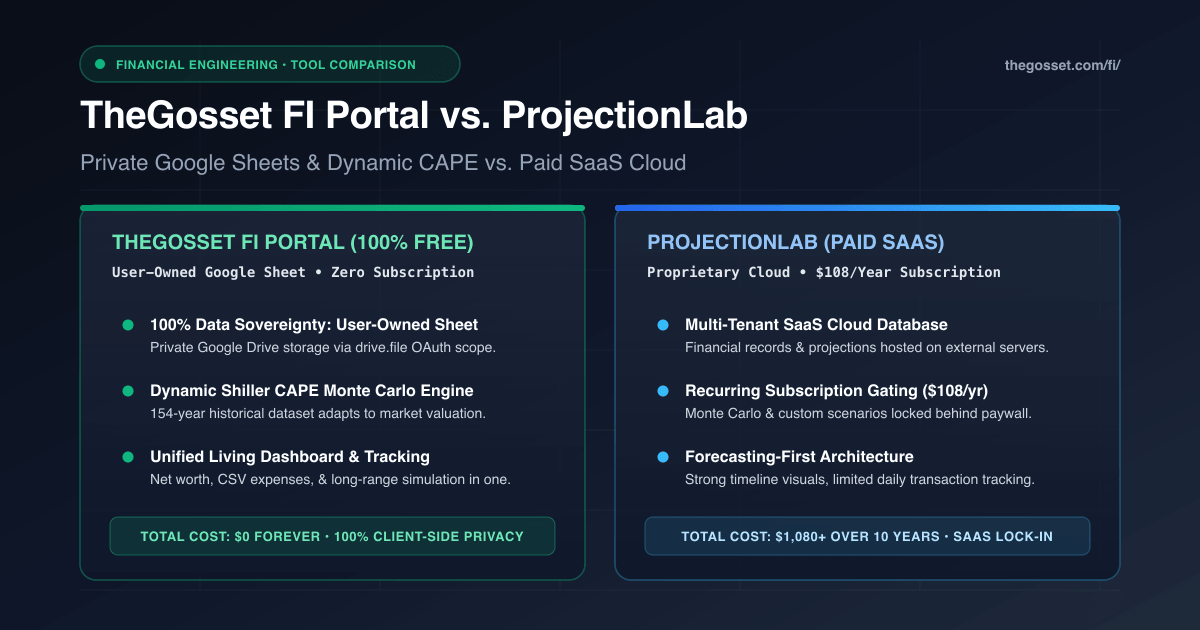
When planning for financial independence, most investors hit a familiar crossroads.
Basic static spreadsheets eventually feel clunky for tracking multi-year asset growth, while traditional personal finance apps like Mint or Personal Capital focus on short-term budgeting and credit card offers rather than long-range early retirement simulation.
In recent years, modern planning tools have filled that void. ProjectionLab has gained considerable popularity in the FIRE community, providing a clean user interface and visual milestone planning.
Yet many investors hesitate when evaluating paid SaaS platforms. Common concerns center around three practical questions:
- Do I want my complete household balance sheet, investment balances, and personal net worth stored on an external cloud database?
- Does paying an ongoing subscription fee ($9 a month, $108 a year, or $500 for a lifetime license) make sense for financial planning software?
- Can I customize formulas, run personalized pivot tables, or link custom bank feeds if the underlying data schema is closed?
TheGosset FI Portal was engineered around a different set of design principles. It delivers a modern, reactive single-page dashboard with zero subscription fees, complete data sovereignty through your own private Google Sheet, and valuation-informed safe withdrawal rate modeling based on Robert Shiller's 1871-to-present dataset.
Here is an empirical, side-by-side technical breakdown of how both tools compare across privacy, simulation depth, daily tracking, and long-term cost.
At-a-Glance Comparison Matrix
| Feature / Dimension | TheGosset FI Portal | ProjectionLab (Premium) |
|---|---|---|
| Pricing | 100% Free ($0 forever) | $9/mo, $108/yr, or $500 lifetime |
| Data Storage Location | Your Private Google Drive | Multi-tenant SaaS cloud servers |
| OAuth Permission Scope | Minimal (drive.file only) |
Account email and cloud login |
| Third-Party Database | Zero (Client-side execution) | Proprietary cloud database |
| Spreadsheet Formula Access | 100% open cell access | Closed UI schema / locked exports |
| Retirement Modeling | Dynamic Shiller CAPE + 154-yr data | Standard Monte Carlo / historical |
| Living Wealth Tracking | Net worth, cash flow, CSV imports | Forecasting-first simulation |
| Onboarding Barrier | Instant Demo Mode (0 sign-up) | Free tier requires account creation |
| Multi-Member Segmentation | Built-in (You, Partner, Joint) | Supported in plans |
| Software Architecture | Client-side HTML5 & Vanilla JS | Web app (Vue.js / Nuxt cloud stack) |
Data Sovereignty: Private Google Sheets vs. Cloud SaaS
The most fundamental difference between the two tools is architectural: where your financial data lives and who controls it.
┌────────────────────────────────────────────────────────────────────────┐
│               System Architecture & Privacy Comparison                 │
├───────────────────────────────────┬────────────────────────────────────┤
│ TheGosset FI Portal               │ ProjectionLab                      │
├───────────────────────────────────┼────────────────────────────────────┤
│ • 100% Client-Side Architecture   │ • Multi-Tenant SaaS Cloud Database │
│ • Private User-Owned Google Sheet │ • Proprietary Cloud Data Storage   │
│ • Minimal OAuth (drive.file scope)│ • Account Sign-Up & Login Required │
│ • Zero Third-Party Cloud Database │ • Cloud-Hosted Simulation Server   │
│ • Full Formula & Cell Access      │ • Locked UI / Closed Schema        │
│ • Data Forever Yours (.xlsx/.gs)  │ • SaaS Export / Platform Lock-In   │
└───────────────────────────────────┴────────────────────────────────────┘
The Client-Side Security Model
TheGosset FI Portal operates as a client-side web application. When you connect your Google Sheet, the portal requests the minimal https://www.googleapis.com/auth/drive.file OAuth permission.
This scope is intentionally restrictive: the application can only view and edit the specific Google Sheet file that you explicitly select using the Google Drive Picker. It cannot view, browse, or read any other files or folders in your Google Drive.
All data parsing, aggregation, and mathematical modeling run entirely in your local browser window. Your financial numbers, account balances, and monthly transactions never pass through an external application database or analytics server.
If this website went offline tomorrow, your data remains completely untouched in your personal Google Drive account. You can open it in Google Sheets, export it to Microsoft Excel, or run SQL queries against it without relying on anyone else.
The SaaS Cloud Model
ProjectionLab hosts user data on external cloud infrastructure. While the platform offers strong encryption standards and local browser caching options, storing long-term financial plans, account structures, and salary figures on third-party servers presents inherent platform risk.
If a subscription lapses, or if platform pricing changes in the future, access to advanced simulation models and historical runs can be restricted.
Retirement Simulation: Dynamic Shiller CAPE vs. Fixed Monte Carlo
Both tools allow you to simulate retirement horizons, but their mathematical engines approach market uncertainty differently.
The Limitation of Static Monte Carlo
Many retirement planners run Monte Carlo simulations using randomized return draws based on long-term historical averages (such as 7% real returns with 15% standard deviation).
The blind spot of static return distributions is that market returns are not independent coin flips. Starting valuations matter enormously. If you retire when the market trades at a cyclically adjusted price-to-earnings ratio of 35 or 40 (such as 1929 or 2000), real equity returns over the subsequent decade are statistically compressed.
Applying a rigid 4% safe withdrawal rate during peak valuations exposes your portfolio to severe Sequence of Returns Risk.
The Dynamic Shiller CAPE Model
TheGosset FI Portal incorporates an empirical, valuation-informed withdrawal engine based on Robert Shiller's 1871-to-present dataset:
SWR_t = α + β · (1 / CAPE_t)
Where α = 1.75% provides a capital preservation floor and β = 0.50 links withdrawal ceilings directly to the prevailing earnings yield.
Instead of assuming flat withdrawal percentages, the portal stress-tests your portfolio across 154 actual market cohorts.
You can inspect exactly how your asset allocation would have performed during the 1929 Great Depression, the 1973 Stagflation crisis, the 2000 Dot-com crash, and the 2008 Great Financial Crisis.
We have explored these empirical dynamics across six detailed case studies:
- Liam: $350k Coast FIRE in the 2000 Lost Decade
- Elena: $600k LeanFIRE in 1970s Stagflation
- Maya: $800k Barista FIRE in the 2008 Crash
- Marcus & Priya: $1.25M Core FIRE in the 2000 Dot-Com Bubble
- David: $2.5M ChubbyFIRE in the 2008 Crash
- The Sterling Family: $5.0M FatFIRE in 2021 All-Time Highs
Living Financial Dashboard vs. Forecasting Simulator
Another key distinction is the operational scope of the two platforms.
ProjectionLab: Forecasting Focused
ProjectionLab excels at hypothetical life sequencing. If you want to visualize a timeline where you buy a home in year three, take a sabbatical in year seven, and purchase an investment property in year twelve, its drag-and-drop milestone builder provides an engaging visual forecast.
However, ProjectionLab is primarily a forecasting tool. It is not designed to serve as your day-to-day financial command center for tracking monthly account statements, categorizing credit card transactions, or monitoring ongoing savings velocity.
TheGosset FI Portal: Unified Financial Command Center
TheGosset FI Portal bridges long-term planning with daily reality across four functional layers:
First, month-end checking, brokerage, and retirement balances can be logged in seconds, with one-click pre-fill from the preceding month to keep balance sheets accurate.
Second, the bank CSV engine batch uploads transactions from Chase, Amex, Capital One, or Vanguard with built-in exclusion rules and merchant memory, eliminating tedious manual data entry.
Third, the cash flow analyzer separates active salaries, side income, and dividend yields from essential and discretionary expenses, calculating your true monthly savings rate.
Fourth, the integrated retirement sandbox lets you test one-off capital expenditures (like real estate down payments or sabbaticals) inside the Capital Outlay Sandbox (#bigDecisionModal) and immediately see the impact on your financial independence timeline.
When to Choose Which Tool
Both tools have distinct engineering strengths. The right choice depends on your personal planning preferences:
Choose ProjectionLab If:
- You prioritize a polished, visual drag-and-drop milestone timeline for modeling complex sequential life events.
- You need built-in tax modeling templates for international jurisdictions (like the UK, Canada, or Australia).
- You prefer entering numbers strictly through form inputs and do not want to interact with spreadsheets.
- You are comfortable paying a $108/year subscription or $500 lifetime fee for cloud software.
Choose TheGosset FI Portal If:
- You believe in total data ownership and want your financial numbers stored securely in your own Google Drive.
- You want zero subscription costs and zero recurring software fees forever.
- You value spreadsheet flexibility, including the ability to write custom
=QUERY()formulas or link third-party data directly into your sheet. - You want an empirical, valuation-informed retirement engine powered by Robert Shiller's 154-year CAPE dataset.
- You want a single integrated platform that tracks your current net worth, logs monthly expenses, and simulates your retirement horizon.
Experience TheGosset FI Portal
You do not need to create an account or provide an email address to explore the software. You can test every dashboard view and simulation engine immediately:
👉 Launch TheGosset FI Portal in Interactive Demo Mode
When you are ready to connect your personal Google Sheet, follow our comprehensive setup walkthrough: