Retiring on $350k: Liam’s Coast FIRE Stress-Test
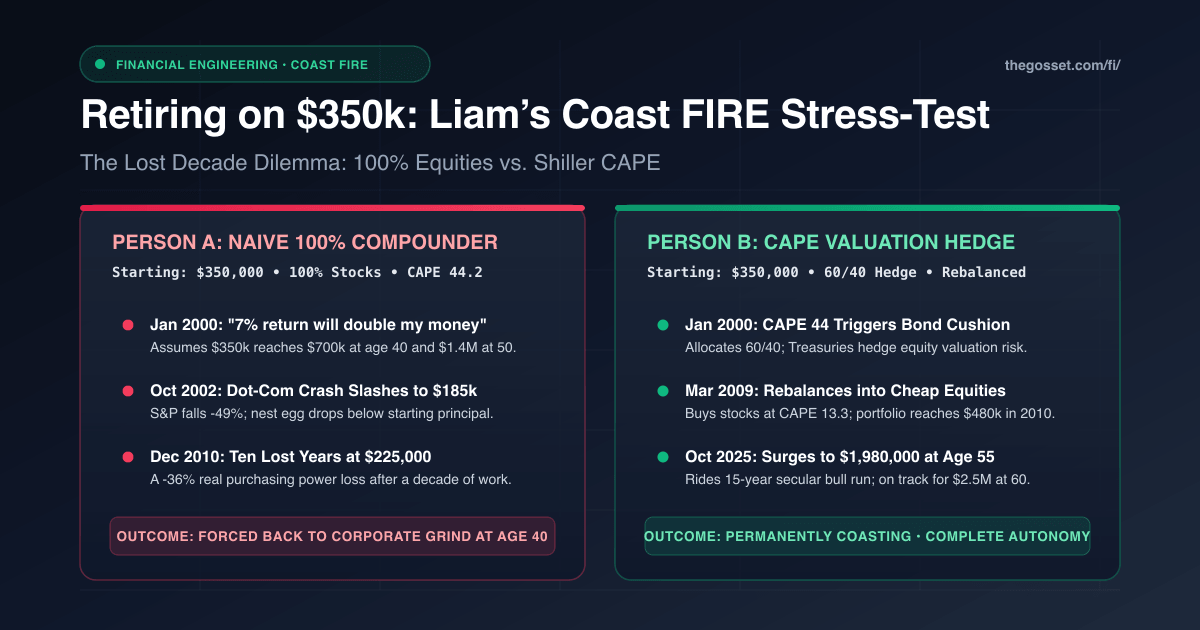
Coast FIRE is built on an appealing promise: front-load your retirement savings in your twenties, step away from high-stress corporate work at age thirty, and never contribute another dollar to retirement accounts for the rest of your life.
Instead of working until your portfolio can support 100% of your expenses immediately (Traditional FIRE) or using your nest egg to supplement part-time income (Barista FIRE), Coast FIRE decouples your present living costs from your retirement savings:
- You earn 100% of your current annual living expenses through enjoyable, lower-stress work.
- You save and invest $0 each year.
- You withdraw $0 from your portfolio for decades.
- Your starting nest egg sits undisturbed, compounding in the background until standard retirement age.
The math sounds simple: if you invest $350,000 at age 30 and leave it alone for 30 years, historical average stock returns of 7% real would theoretically double your money every decade. On paper, $350,000 becomes $700,000 at age 40, $1.4 million at age 50, and $2.8 million at age 60.
The hidden catch is valuation risk.
When you start coasting at extreme equity valuations, average returns do not happen. Between January 2000 and January 2010, the S&P 500 delivered a -2.8% real annualized return, a period historians call the Lost Decade.
To see how Coast FIRE survives when long-term compounding stalls, let's examine two identical 30-year-old investors, both named Liam. Both accumulated $350,000 working in enterprise software sales in Austin, Texas. Both stepped away from corporate quota pressure in January 2000 to teach high school robotics and build custom furniture.
One Liam panicked at age 40 when his portfolio had lost purchasing power, forcing him back into 60-hour corporate sales. The other reached age 55 with $1.98 million, fully on track for complete independence at age 60.
Liam's $45,000 Coast FIRE Blueprint
Liam rented a workshop apartment and kept his fixed overhead predictable. His goal was not complete leisure, but autonomy over his working hours.
His $45,000 annual living budget ($3,750/month) matched his active earnings dollar for dollar:
┌────────────────────────────────────────────────────────────────────────┐
│                   Liam's Coast FIRE Architecture                       │
│              $45,000 Annual Living Budget • $0 Portfolio Draw          │
├────────────────────────────────────────────────────────────────────────┤
│ 1. EARNED ACTIVE INCOME (Covering 100% of Expenses): $45,000/yr        │
│    • High school robotics instruction:    $2,750/mo ($33,000/yr)       │
│    • Custom woodworking & furniture:      $1,000/mo ($12,000/yr)       │
│                                                                        │
│ 2. ANNUAL LIVING EXPENDITURES: $45,000/yr ($3,750/mo)                  │
│    • Housing, health insurance, & food:   $2,667/mo ($32,000/yr)       │
│    • Workshop tools & climbing trips:     $1,083/mo ($13,000/yr)       │
│                                                                        │
│ 3. THE UNTOUCHED COMPOUNDING CORE: $350,000 Start at Age 30            │
│    • Annual Retirement Additions:         $0 / Year (100% Coasters)    │
│    • Annual Portfolio Withdrawals:        $0 / Year (100% Preserved)   │
│    • Investment Horizon:                  30 Years (Age 30 to Age 60)  │
└────────────────────────────────────────────────────────────────────────┘
Notice the key difference between Liam and our other case studies:
- Elena ($600k LeanFIRE) and Marcus & Priya ($1.25M Core FIRE) had to draw living expenses from their investments immediately.
- Maya ($800k Barista FIRE) drew $24,000 a year from her portfolio to supplement part-time wages.
- Liam withdraws $0. His portfolio is insulated from withdrawal sequence risk.
However, Liam faces a different threat: Compounding Drag. If his nest egg fails to grow during his thirties, he loses the single most valuable advantage in personal finance: thirty uninterrupted years of compound interest.
Two Strategies on the Eve of 2000
In January 2000, both Liams walked away from their corporate careers and locked in their investment allocations.
Person A: The Blind Compounder
Person A followed mainstream Coast FIRE advice:
"The S&P 500 has averaged roughly 10% nominal and 7% real returns over long horizons," Liam A reasoned. "I am only thirty years old. I have thirty full years until age sixty. Even if the market drops short term, I don't need the money today. I will put 100% into the S&P 500 and let compounding do the heavy lifting."
Liam A put all $350,000 into total market index funds. He assumed he would never have to touch or think about the allocation until 2030.
Person B: Valuation Discipline and Tactical Rebalancing
Person B checked the valuation climate using our foundational guide on Dynamic Safe Withdrawal Rates & Shiller CAPE.
He discovered that in January 2000, the Shiller CAPE ratio stood at 44.2, the highest level in modern American history:
Real Earnings Yield = 1 / CAPE_2000 = 1 / 44.2 = 2.26%
When equity valuations sit at historic extremes, expected forward 10-year real returns drop close to zero.
Liam B understood that counting on 7% real compounding from the most expensive market peak in a century was a reckless bet.
Instead of going 100% equities, he instituted two structural safeguards:
- The Valuation-Weighted Glidepath: At CAPE 44.2, Liam B allocated 60% to broad equities and 40% to intermediate Treasury bonds and TIPS. High-quality Treasuries offered 6.5% risk-free yields in early 2000.
- Asymmetric Rebalancing Triggers: If market valuations compressed dramatically (CAPE falling below 25), he would rebalance fixed income gains directly into cheap equities, acquiring shares at steep discounts.
What Happened During the 2000-2010 Lost Decade
What unfolded was the Dot-Com Crash followed seven years later by the Great Financial Crisis.
┌────────────────────────────────────────────────────────────────────────┐
│             Lost Decade Stress-Test: Liam's Portfolio (2000-2010)      │
│                                                                        │
│  Jan 2000: Both Start at $350,000 (CAPE = 44.2)                        │
│  ──────────────────────────────────────────────                        │
│  Oct 2002 (Dot-Com Bottom, S&P -49%):                                  │
│    • Person A (100% equities, no rebalance): Portfolio = $185,000      │
│    • Person B (60/40 allocation + bond hedge):Portfolio = $315,000     │
│                                                                        │
│  Mar 2009 (GFC Market Trough, S&P -56%):                               │
│    • Person A (S&P whipsawed again):         Portfolio = $195,000      │
│    • Person B (Rebalanced bonds into cheap eq):Portfolio = $360,000    │
│                                                                        │
│  Dec 2010 (10-Year Mark / Age 40 Assessment):                          │
│    • Person A: Portfolio Stalls at $225,000 (-36% Real Loss, Panics)   │
│    • Person B: Portfolio Climbs to $480,000 (+37% Real Gain, Coasts)   │
└────────────────────────────────────────────────────────────────────────┘
The Breakdown for Person A
Between 2000 and 2002, the technology-heavy market collapsed. By October 2002, the S&P 500 had dropped 49%.
Liam A watched his $350,000 portfolio sink to $185,000. Because he was working full-time in his teaching and carpentry jobs, he covered his living expenses without withdrawing from the portfolio. But his nest egg was now smaller than when he was 26 years old.
The market recovered modestly between 2003 and 2007, lifting Liam A's balance back to $365,000. But then the 2008 Great Financial Crisis hit, and equities plummeted another 56%. By March 2009, his balance plunged to $195,000.
By December 2010, ten full years after entering Coast FIRE:
- Liam A was 40 years old.
- His portfolio was worth $225,000.
- Factoring in ten years of cumulative inflation, he had suffered a 36% loss in real purchasing power.
- Instead of the $700,000 balance promised by the 7% doubling rule, he was $475,000 behind schedule.
Panicked that he had wasted ten critical years of compounding and would reach retirement age with insufficient savings, Liam A abandoned Coast FIRE in 2011. He updated his resume, rejoined an enterprise software firm, and spent his forties working 60-hour weeks under strict quarterly quotas.
How Person B Handled the Decade
Liam B experienced the exact same market drops, but his valuation-weighted allocation protected his capital.
When equities crashed in 2000-2002:
- His 40% bond allocation produced strong positive returns as interest rates dropped, softening the blow of falling stock prices.
- In October 2002, when the S&P 500 had lost half its value and Shiller CAPE dropped to 22, Liam B executed his first rebalancing trigger. He moved $40,000 from appreciated Treasury bonds into discounted index funds.
- When the 2008 crisis hit, Liam B's fixed income allocation once again buffered the decline. At the March 2009 bottom, with CAPE falling to 13.3, he rebalanced again, shifting another $45,000 into equities at generational lows.
By December 2010, at age 40:
- Liam B's portfolio stood at $480,000.
- Despite living through the worst decade for equities since the Great Depression, he achieved a 37% net real gain.
- His portfolio held more than double the share units of Person A, positioning him perfectly for the next bull market.
The 25-Year Trajectory (2000 through 2025)
Over the following fifteen years, the power of untouched compounding finally took hold.
┌────────────────────────────────────────────────────────────────────────┐
│             The 25-Year Trajectory: 2000 through 2025                  │
│                                                                        │
│ $2.0M  ┬                                            Person B: $1.98M   │
│        │                                           ┌─────────────────  │
│ $1.5M  ┼                                          ┌┘                   │
│        │                                         ┌┘                    │
│ $1.0M  ┼                              ┌──────────┘                     │
│        │                 /\          ┌┘                                │
│  $500k ┼───────────┐    /  \________/               Person A: $780k    │
│        │            \__/                            (Re-entered at 40) │
│    $0  ┴───────────────────────────────────────────────────────────────│
│       2000   2003   2007   2009   2013   2017   2021   2025            │
└────────────────────────────────────────────────────────────────────────┘
Person A: Rebuilding from Scratch
By going back to corporate sales at age 40, Liam A was able to save $40,000 a year from his salary.
By 2025, at age 55, his portfolio reached $780,000. But he achieved that balance through fifteen years of high stress, long hours, and missing out on his woodworking workshop. He traded fifteen of his healthiest years to make up for an unhedged valuation mistake made at age thirty.
Person B: Compounding into Complete Freedom
Because Liam B accumulated surplus equity shares during the 2002 and 2009 bottoms, his nest egg expanded rapidly during the 2010-2025 economic expansion:
- By 2015, at age 45, his portfolio reached $820,000.
- By 2020, at age 50, his balance crossed $1,250,000.
- By 2025, at age 55, his nest egg stood at $1,980,000.
Without ever contributing an additional dollar from active work, Liam B turned $350,000 into nearly $2 million while continuing to teach robotics and build furniture on his own schedule.
At age 60, projected to cross $2.5 million, he can comfortably transition into full retirement with an annual spending capacity of over $90,000 at a 3.5% withdrawal rate.
The 25-Year Scorecard
Here is how the two Coast FIRE paths compared across a quarter century:
| Metric (After 25 Years) | Person A (Blind Compounder) | Person B (CAPE Valuation Hedge) |
|---|---|---|
| Starting Nest Egg (Age 30) | $350,000 | $350,000 |
| Portfolio at Age 40 (2010) | $225,000 (-36% real loss) | $480,000 (+37% real gain) |
| Portfolio at Age 55 (2025) | $780,000 (via forced savings) | $1,980,000 (100% pure compounding) |
| Career Status at Age 55 | 15 years back in corporate sales | 25 years of schedule autonomy |
| Additional Savings Required | $40,000/yr saved from salary | $0 additional savings contributed |
| Trough Rebalancing | Held 100% equities through crash | Rebalanced bonds into cheap equities |
The Coast FIRE Playbook: How to Protect Your Coast Number
If you plan to stop retirement contributions in your twenties or thirties, relying on naive 7% compounding curves is dangerous. Use these core guidelines to safeguard your timeline:
1. Check Starting Valuations
Before you step away from high-income savings, evaluate where market valuations sit. When the Shiller CAPE is above 30, expected real returns over the next decade are depressed. Do not assume your portfolio will double in ten years if you enter at peak multiples.
2. Implement a Valuation-Weighted Allocation
If CAPE is stretched when you begin coasting, hold a dedicated 20% to 40% allocation in high-grade bonds or cash equivalents. This provides capital preservation and gives you dry powder to rebalance when the market drops.
3. Rebalance Aggressively During Crashes
When equity markets suffer major drawdowns and CAPE compresses below historical medians, rebalance fixed income into equities. Buying shares at valuation bottoms accelerates your long-term compounding when the secular recovery arrives.
4. Backtest Your Specific Coast Plan
Different retirement ages, living expenses, and starting portfolios require customized modeling. You can simulate your personal numbers across all 154 historical market cohorts using our free client-side tool:
👉 Simulate Your Portfolio in TheGosset FI Portal
If you have not connected your private dashboard yet, follow our step-by-step setup guide:
👉 Setting Up TheGosset FI Portal: Step-by-Step Guide
The Complete Shiller CAPE Avatar Cluster
Explore the complete collection of real-world A/B case studies across every wealth tier:
- 📚 Foundational Guide: Dynamic Safe Withdrawal Rates: Why Shiller CAPE Beats the 4% Rule
- 🚲 LeanFIRE ($600k): Retiring on $600k: Elena’s LeanFIRE Stress-Test in 1970s Stagflation
- ☕ Barista FIRE ($800k): Retiring on $800k: Maya’s Barista FIRE Stress-Test in the 2008 Crash
- 👨👩👧👦 Core FIRE ($1.25M): Retiring on $1.25M: Marcus & Priya's 4% Rule vs. Shiller CAPE A/B Test
- 🎿 ChubbyFIRE ($2.5M): Retiring on $2.5M: David’s ChubbyFIRE Stress-Test in the 2008 Crash
- 🏰 FatFIRE ($5.0M): Retiring on $5M: The Sterlings’ FatFIRE Blueprint in the 2022 Crash