Financial Order of Operations: Savings Waterfall Guide
Most financial advice tells you to save fifteen percent of your income and hope for the best. That generic rule ignores the basic mechanics of the United States tax code.
Every dollar you save carries an opportunity cost. If you put five hundred dollars into a taxable brokerage account while leaving employer 401(k) matching dollars on the table, you throw away an instant one hundred percent return. If you fund a standard taxable account before exhausting your Health Savings Account or voluntary after-tax 401(k) space, you voluntarily pay taxes on dividends and capital gains for the next thirty years.
Math beats discipline. When you automate your capital through a rigorous, sequential waterfall, you eliminate emotional decisions and capture every legal tax shelter available to high earners.
Here is the exact mathematical sequence to allocate every dollar of income, from your initial emergency buffer to the Mega Backdoor Roth.
The Core Problem: The Lifetime Tax Drag of Ad-Hoc Saving
Consider two software engineers, Alex and Jordan. Both earn $180,000 per year and save $60,000 annually.
Alex saves money without a sequence. He puts $10,000 in his 401(k), skips his company Health Savings Account because he feels healthy, leaves his after-tax 401(k) empty, and deposits the remaining $50,000 into a retail taxable brokerage account buying index funds.
Jordan follows a strict Financial Order of Operations waterfall:
- She captures her complete employer 401(k) match.
- She maxes out her employee 401(k) elective deferral ($24,500 in 2026).
- She maxes out her Health Savings Account ($4,400 individual limit).
- She executes a Backdoor Roth IRA ($7,500).
- She channels the remainder into her plan voluntary after-tax 401(k) space ($23,600) with automatic in-plan conversion to Roth.
Both engineers live on the exact same budget and save the exact same $60,000.
Over a 20-year career compounding at an 8% nominal annual return, Jordan accumulates over $420,000 more in after-tax net wealth than Alex. That gap does not come from stock picking or taking more risk. It comes entirely from eliminating dividend tax drag and avoiding capital gains taxes inside sheltered accounts.
The 5-Stage Financial Order of Operations (Savings Waterfall)
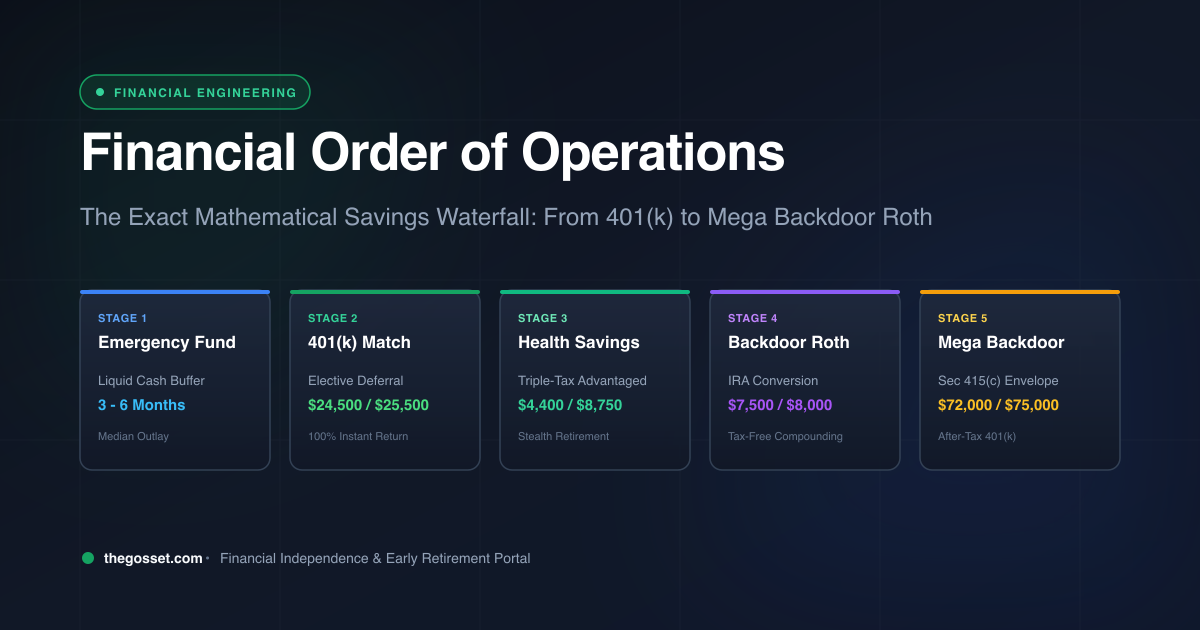
The waterfall functions as a series of sequential buckets. Capital flows into Bucket 1 until full, spills into Bucket 2, and continues downward.
┌────────────────────────────────────────────────────────────────────────┐
│             Financial Order of Operations (Savings Waterfall)          │
│                                                                        │
│  [Gross Paycheck / Cashflow Inflows]                                   │
│            │                                                           │
│            ▼                                                           │
│  [Stage 1: Liquid Emergency Buffer] ────► 3 to 6 Months Median Outlay  │
│            │                                                           │
│            ▼                                                           │
│  [Stage 2: 401(k) Match & Deferral] ────► $24,500 (2026) / $25,500 (27)│
│            │                                                           │
│            ▼                                                           │
│  [Stage 3: Health Savings Account]  ────► $4,400 / $8,750 (2026 Limits)│
│            │                                                           │
│            ▼                                                           │
│  [Stage 4: Backdoor Roth / IRA]     ────► $7,500 (2026) / $8,000 (2027)│
│            │                                                           │
│            ▼                                                           │
│  [Stage 5: Mega Backdoor Roth]      ────► Up to $72,000 Sec 415(c) Cap │
│            │                                                           │
│            ▼                                                           │
│  [Stage 6: Taxable Brokerage]       ────► Uncapped Capital Accumulation│
└────────────────────────────────────────────────────────────────────────┘
Let us examine the exact mathematical priority of each stage.
Stage 1: The Liquid Emergency Reserve
Before investing a single dollar in volatile markets, you need an operational cash buffer.
Do not pick an arbitrary round number like $10,000 or $50,000. Your cash reserve should scale directly with your actual trailing twelve-month median living expenses:
Total Liquid Cash & Equivalents ÷ Median Monthly Expenses (LTM)
We divide liquid reserve targets into three distinct safety tiers:
| Safety Tier | Recommended Horizon | Target Household Profile |
|---|---|---|
| Baseline Buffer | 3 Months Median Outlay | Dual-earner households with stable, non-cyclical employment |
| Optimal Cushion | 6 Months Median Outlay | Tech workers, single earners, or volatile job markets |
| Fortress Tier | 12 Months Median Outlay | Freelancers, founders, or households within two years of early retirement |
Keep these funds strictly in liquid cash or high-yield savings accounts. The purpose of this money is not capital appreciation. The purpose is keeping you from selling equities during a market downturn to pay rent.
Stage 2: Employer 401(k) Match & Employee Deferrals
Employer matching contributions represent an instantaneous, guaranteed return on investment. If your employer offers a dollar-for-dollar match up to 4% of your salary, contributing that 4% earns an immediate 100% return on day one. No equity index or bond fund can compete with that math.
Once you capture the full match, continue funding employee elective deferrals up to the statutory annual ceiling:
| Provision | 2025 Limit | 2026 Limit | 2027 Limit (Projected) |
|---|---|---|---|
| 401(k) / 403(b) Elective Deferral | $23,500 | $24,500 | $25,500 |
| Standard Catch-Up (Age 50+) | $7,500 | $8,000 | $8,500 |
For high earners facing federal marginal brackets of 32% or 35% plus state income taxes, prioritizing traditional pre-tax contributions is almost always superior to Roth deferrals. You deduct contributions at your peak marginal rate today, and withdraw at lower effective brackets during early retirement before required minimum distributions begin.
Stage 3: The Health Savings Account (HSA)
The Health Savings Account is the most tax-efficient investment vehicle in the United States tax code. While traditional retirement accounts are double-tax-advantaged, the HSA is triple-tax-advantaged:
- Contributions are 100% tax-deductible (pre-tax payroll contributions also bypass the 7.65% FICA tax).
- Investments compound completely tax-free inside the account.
- Withdrawals for qualified medical expenses are 100% tax-free at any age.
| Coverage Type | 2025 Limit | 2026 Limit | 2027 Limit (Official IRS Rev. Proc. 2026-24) |
|---|---|---|---|
| Self-Only HDHP | $4,300 | $4,400 | $4,500 |
| Family HDHP | $8,550 | $8,750 | $9,000 |
| Catch-Up (Age 55+) | $1,000 | $1,000 | $1,000 |
To extract maximum value, do not use your HSA to pay for current doctor visits or prescriptions. Pay routine medical bills out of pocket with cash flow, save every digital receipt in cloud storage, and invest 100% of your HSA balance in low-cost equity index funds.
Because current tax law places no expiration date on when you must reimburse yourself, you can let that money compound for twenty years and withdraw thousands of dollars completely tax-free in early retirement.
Stage 4: Backdoor Roth IRA
Once your workplace retirement plan and HSA are maxed, individual retirement accounts offer the next layer of tax sheltering:
| Provision | 2025 Limit | 2026 Limit | 2027 Limit (Projected) |
|---|---|---|---|
| IRA Contribution Limit | $7,000 | $7,500 | $8,000 |
| IRA Catch-Up (Age 50+) | $1,000 | $1,100 | $1,100 |
High earners quickly exceed the IRS modified adjusted gross income phase-out limits for direct Roth IRA contributions. The solution is the two-step Backdoor Roth IRA:
- Make a non-deductible contribution to a traditional IRA.
- Once the cash settles, immediately convert the balance to a Roth IRA.
Be careful with the IRS pro-rata rule. If you hold existing pre-tax balances in traditional, SEP, or SIMPLE IRAs on December 31, the IRS taxes your conversion proportionally across all IRA assets. Roll any existing traditional IRA balances into your active employer 401(k) before executing a Backdoor Roth to reset your pre-tax IRA balance to zero.
Stage 5: Voluntary After-Tax 401(k) (Mega Backdoor Roth)
Most people assume the 401(k) stops at $24,500. For employees at major technology firms and progressive employers, that is only the beginning.
Under Internal Revenue Code Section 415(c), the statutory limit on total defined contribution additions is far higher than the employee elective deferral:
| Tax Year | Section 415(c) Limit (Per Earner) | Section 415(c) Household Limit (2 Earners) |
|---|---|---|
| 2025 | $70,000 | $140,000 |
| 2026 | $72,000 | $144,000 |
| 2027 (Projected) | $75,000 | $150,000 |
The Section 415(c) ceiling caps all additions to your retirement account across three distinct sources:
- Your employee pre-tax or Roth elective deferrals ($24,500 in 2026).
- Your employer matching and non-elective contributions.
- Your voluntary after-tax contributions.
Sec 415(c) Ceiling - Employee Elective Deferral - Employer Match
If your plan supports voluntary after-tax contributions with automated daily in-plan Roth conversion, you can funnel tens of thousands of extra dollars each year directly into Roth status.
For example, if your employer contributes $10,000 in matching funds in 2026 and you contribute your $24,500 deferral, you still have $37,500 in remaining after-tax space ($72,000 minus $34,500). That entire $37,500 can be contributed and immediately converted to Roth, locking in tax-free growth forever.
Stage 6: Taxable Brokerage & Dedicated Sinking Funds
Only after you have filled Stages 2 through 5 does excess cash flow spill into your standard taxable brokerage account.
A taxable brokerage account lacks the upfront deduction of a 401(k) and the tax-free distributions of a Roth, but it offers total liquidity:
- No early withdrawal penalties prior to age 59.5.
- Favorable long-term capital gains tax rates (0%, 15%, or 20% depending on taxable income).
- Flexible collateral for asset-backed lines of credit.
At this stage, also segregate near-term life goals using dedicated sinking funds. Ring-fencing down payments, vehicle replacements, and tax reserves into separate accounts ensures you never liquidate equities during a bear market to fund planned life events.
Tracking Your True Savings Velocity
Financial independence comes down to savings velocity. To track your actual progress across paycheck deductions and post-tax transfers, calculate your True Savings Rate:
(Pre-Tax 401k/HSA + Post-Tax Brokerage + Cash Surplus) ÷ Gross Income × 100
Notice that employer matching dollars are treated as an addition to your compensation envelope rather than a paycheck deduction. Tracking this metric month over month shows your true capital accumulation efficiency.
Modeling Your Savings Waterfall in the FI Portal
Tracking these thresholds manually across spreadsheets and payroll portals is tedious.
We built the Savings Rate & Financial Order of Operations Engine directly into the TheGosset FI Portal:
┌────────────────────────────────────────────────────────────────────────┐
│  TheGosset FI Portal: Live Savings Waterfall Dashboard (/fi/savings/)  │
│                                                                        │
│  [Emergency Runway Gauge]  ───► Real-time months vs 3/6/12 targets     │
│  [Waterfall Stage Tracker] ───► Track pacing across 2026 and 2027 caps │
│  [Section 415(c) Envelope] ───► Cumulative tracking for Mega Backdoor  │
│  [Target Sinking Buckets]  ───► Ring-fenced capital progress bars      │
└────────────────────────────────────────────────────────────────────────┘
The portal connects directly to your private Google Sheet through client-side API calls. It automatically pulls your actual payroll inflows, compares your contributions against statutory IRS limits for tax years 2020 through 2027, and calculates your remaining tax shelter capacity in real time.
You can explore the live waterfall engine in instant Demo Mode at /fi/savings/ or connect your own private spreadsheet to audit your capital allocation today.